
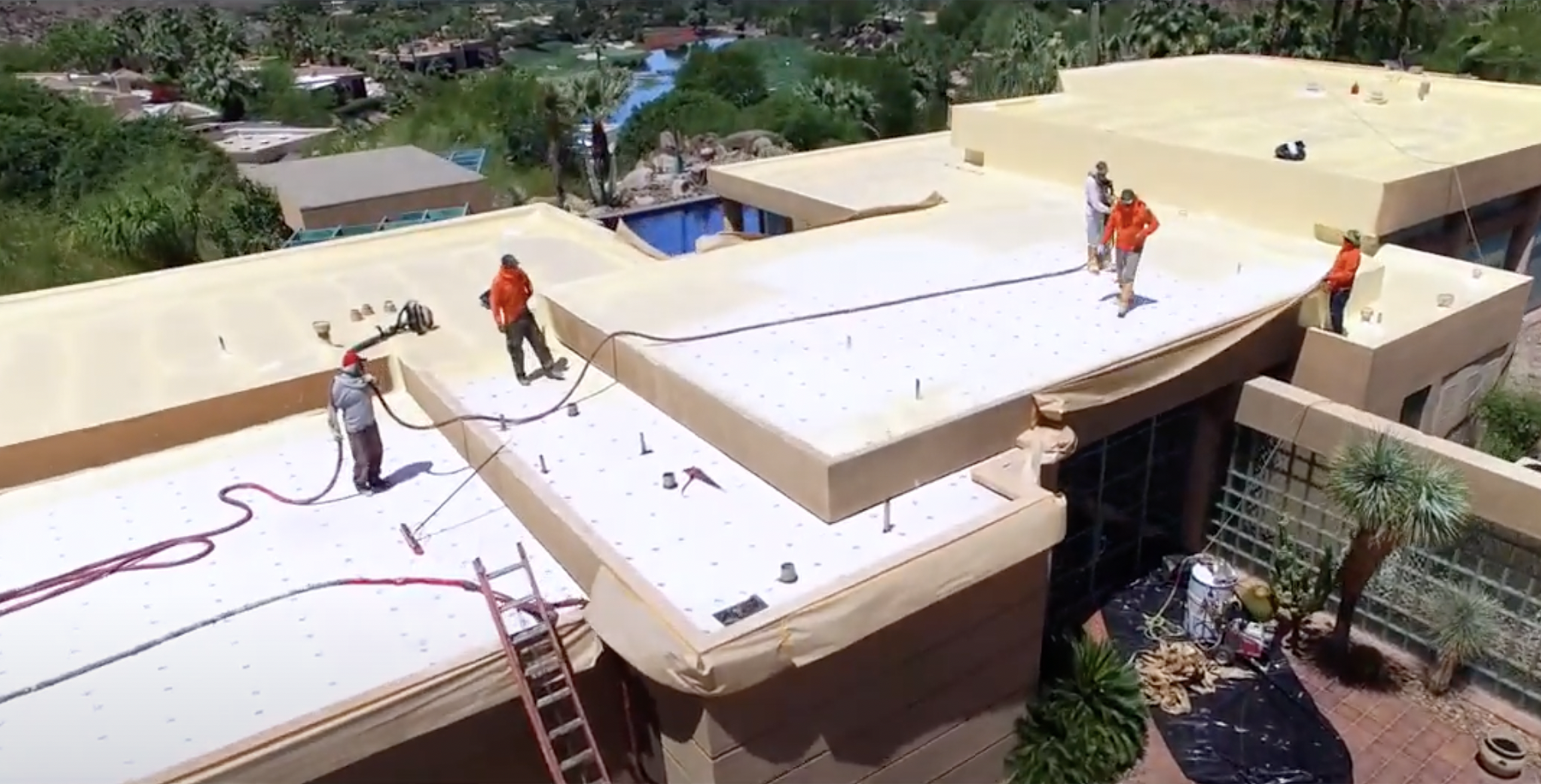
Spray polyurethane foam roofing has found a specific and defensible niche in the St. Petersburg commercial market that is distinct from the applications where TPO or modified bitumen are the default choice. The characteristic that makes SPF uniquely valuable in this niche is its ability to self-adhere and build up a continuous, seamless waterproofing layer over irregular roofline profiles — mansard parapets, built-up curbs, irregular roof transitions between building sections at different elevations, and the complex geometry of mixed-use buildings in downtown St. Pete's historic commercial districts where architectural variety creates roofscape conditions that standard sheet-goods membranes must be extensively cut, welded, and detailed to cover. In those applications, SPF's seamless application eliminates the penetration flashing and transition details that drive the highest percentage of membrane system failures.
The Warehouse Arts District, the EDGE District, and the historic mixed-use commercial blocks along Central Avenue and Beach Drive represent the St. Pete building segment where SPF's irregular-roofline advantage is most often relevant. These buildings — many dating to the 1920s through 1950s — were not designed with low-slope roofing simplicity in mind. They have parapet walls of varying heights, penthouse structures, exterior stair enclosures, rooftop sign bases, and equipment housings that collectively create hundreds of linear feet of transition details per building. Each of those transitions is a potential seam failure point on a membrane system. SPF eliminates the seam by spraying around and over all of those transitions continuously, creating a monolithic waterproofing surface that bends and follows the substrate geometry rather than requiring the membrane to be cut and welded to fit it.
The non-negotiable requirement for SPF roofing in Florida is a UV-protective topcoat applied immediately after the foam has cured. Spray foam without topcoat protection degrades catastrophically under direct UV exposure — the surface chalks, develops surface cracking within weeks, and loses closed-cell structure at the surface layer within months. In St. Pete's subtropical sun, an unprotected SPF surface cannot survive a single summer. The topcoat requirement is absolute, not optional, and silicone is the dominant topcoat choice in the Florida market because silicone's UV stability and ponding-water resistance complement SPF's insulation and adhesion advantages. The silicone topcoat over SPF creates the same cool-roof energy performance (white silicone achieves 0.85+ Solar Reflectance) as a standalone silicone coating system, while the SPF beneath provides the added insulation value that improves building energy performance beyond what coating alone delivers.
Application timing is a critical constraint for SPF work in St. Pete's wet-season climate. SPF requires a dry substrate and ambient relative humidity below approximately 80 percent for proper cell formation and adhesion. St. Pete averages relative humidity above 80 percent during much of the June-September wet season — particularly in the mornings before solar heating reduces surface moisture — and afternoon thunderstorms create conditions that make any outdoor SPF application after about 1:00 PM in summer a scheduling gamble. Practically, this means that SPF projects in St. Pete during wet season are executed in early-morning windows, with crews prepared to stop and cover materials if afternoon development arrives ahead of schedule. Pre-wet-season timing — completing SPF projects by mid-May — is the most reliable approach for projects where schedule certainty is important.
R-value is one area where SPF holds a genuine advantage over thin membrane systems in Florida's climate. Closed-cell spray foam at two inches of thickness achieves approximately R-12 to R-14, and at three inches approaches R-18 to R-21. Applied directly over an existing roof substrate, SPF simultaneously provides insulation and waterproofing — a combination that requires separate insulation board and membrane layers in conventional systems. On St. Pete commercial buildings with minimal existing insulation above older decks, SPF roofing can deliver meaningful cooling-load reduction as part of the roofing restoration rather than requiring separate insulation work as a prerequisite for new membrane installation.
Hurricane wind resistance of SPF roofing is a question that deserves specific attention in a Pinellas County context. SPF adheres directly to the substrate without mechanical fasteners — its wind-uplift resistance comes from the bond between the foam and the substrate, not from fastener embedment. When properly applied to a clean, dry, and mechanically sound substrate, SPF achieves wind-uplift resistance values that meet or exceed FBC requirements for most Pinellas County building locations. When applied over a compromised substrate — a membrane with delamination areas or insulation with poor deck bond — SPF's adhesive wind-uplift resistance is limited to the weakest bond in the assembly below it. Substrate assessment before SPF application is therefore critical for wind-uplift compliance in this hurricane market.
Maintenance and recoating define SPF's long-term economics in St. Pete. A quality silicone topcoat on an SPF system typically requires recoating every 10 to 15 years as the topcoat's UV stability is gradually consumed by Florida's solar radiation. The recoating process — surface cleaning, inspection and repair of any foam erosion areas, and application of a new silicone flood coat — is substantially less expensive than full membrane replacement and can be repeated indefinitely as long as the underlying foam structure remains sound. In theory, an SPF roof with periodic recoating has an indefinite service life — the foam substrate does not age the way bitumen or thermoplastic polymers do. In practice, foam systems that sustain significant bird or maintenance traffic damage, or that were not initially applied to adequate thickness, require foam repair or replacement sections as part of the recoating process.
Rooftop traffic management is more important for SPF systems than for membrane systems in St. Pete commercial applications. SPF is more vulnerable to surface erosion from foot traffic — particularly point-load traffic from maintenance workers accessing HVAC equipment — than flexible membrane systems. Walking pads, maintenance routes, and equipment access paths should be established at SPF installation time and maintained as part of the building's roof access management program. Heavy equipment access — rooftop HVAC replacement, antenna work — requires temporary protection boards placed before the work begins. HVAC contractors and other trades working on rooftops of SPF-roofed St. Pete buildings should be briefed on surface protection requirements before their first access, not after the damage is done.
Questions Owners Ask
Is SPF roofing appropriate for a simple flat warehouse in St. Petersburg, or is it mainly for complex buildings?
SPF is technically applicable to any commercial roof, but its cost and application complexity advantages are most realized on buildings with complex geometry where membrane alternatives require extensive cutting and detailing. A simple rectangular flat warehouse roof — the typical Gateway area or Ulmerton Road industrial building — is usually better served by TPO or modified bitumen, which are faster to install, easier to repair if damaged, and less sensitive to application timing constraints. For straightforward flat roofing, SPF's complexity and application window constraints don't justify its advantages over conventional membrane systems. For irregular, historically detailed, or penetration-dense rooftops, those advantages become compelling.
Can SPF be applied over an existing roof without tear-off in St. Pete?
Yes, provided the substrate meets the same qualifying criteria as any recover: no more than one existing roof layer, dry insulation confirmed by core cuts, and a mechanically sound existing surface. SPF applied over wet insulation in Florida's warm climate will trap that moisture in the assembly permanently, accelerating biological growth and understructure degradation without providing any escape path. Substrate moisture assessment is non-negotiable before any SPF application, and the confirmation method (core cuts, probe testing) must be thorough enough to characterize the entire roof area, not just sample points near the building perimeter.
How thick does spray foam need to be on a St. Pete commercial roof?
Minimum practical thickness for a commercial SPF roofing application is 1.5 to 2 inches, which provides a closed-cell foam structure with adequate compressive resistance for maintenance traffic and adequate insulation value for energy performance in Florida's climate zone. Many Florida commercial SPF installations are specified at 2 to 3 inches for improved R-value and greater surface erosion tolerance over the system's service life. Thinner applications — below 1.5 inches — are generally not appropriate for commercial roofing due to inadequate compressive resistance and limited insulation contribution.
How do I maintain an SPF roof on my St. Pete commercial building?
Annual inspection is the foundation: checking topcoat integrity for chalking or surface erosion, inspecting all penetration details for foam-to-substrate bond condition, and clearing drains of any accumulated debris. Areas showing topcoat chalking beyond light surface haze warrant recoating planning within one to two years. Areas showing foam surface erosion (granular texture where the surface layer has degraded) require localized foam repair before recoating to restore the waterproofing layer thickness. All maintenance should be documented for the recoating contractor's reference when the full recoat cycle arrives.
What happens to an SPF roof after a hurricane impact in St. Petersburg?
SPF's seamless character means that hurricane-generated debris impact creates punctures rather than seam failures — the failure mode is different from membrane systems but the entry-point mechanism is similar. Post-hurricane inspection of an SPF roof should specifically look for impact punctures from debris, which appear as craters or open holes in the foam surface where the topcoat and foam have been displaced. These require foam injection repair and topcoat patch before rain infiltration can occur through the puncture. Large debris impacts may require removal of the embedded material, foam buildup to restore grade, and topcoat application. Overall, SPF's bonded, continuous character provides good wind-uplift resistance during hurricane events when properly installed over a sound substrate.
 Commercial Roof Repair in St. Petersburg | Planned & Emergency
 Commercial Re-Roofing
 Occupied Building Re-Roofing
 Roof Recover and Overlay