
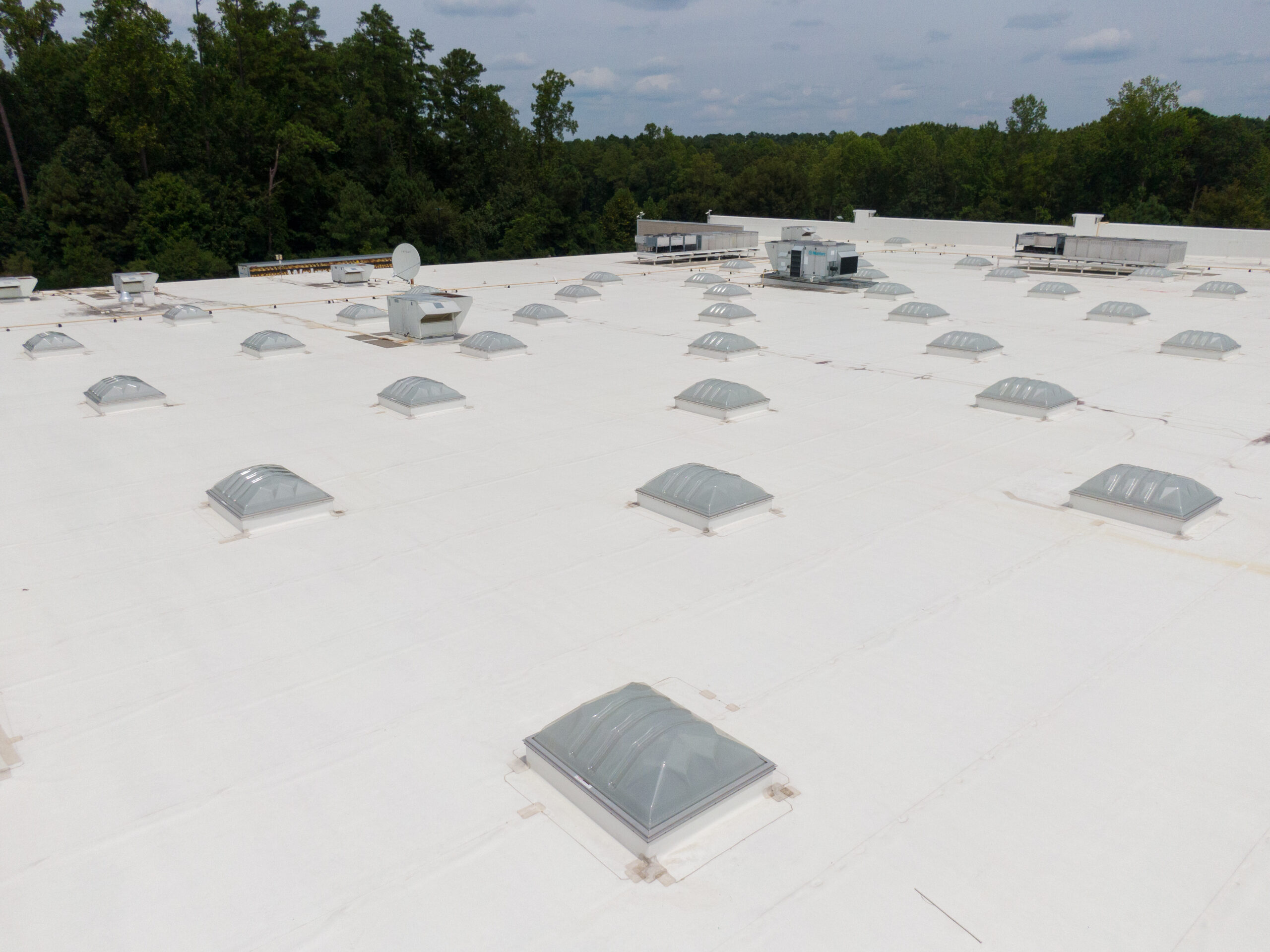
St. Petersburg has undergone a restaurant renaissance over the past decade, with Central Avenue's walkable dining district, the Edge District's independent food halls, and the waterfront restaurants along Beach Drive drawing visitors and residents year-round to one of Florida's most vibrant urban dining scenes. Behind those kitchens, flat commercial roofs face some of the harshest weather in the Southeast: intense summer UV, afternoon thunderstorms that drop three inches of rain in under an hour, high ambient humidity that rarely drops below 60 percent even overnight, and the ever-present threat of tropical cyclone wind loads during Atlantic hurricane season. Every restaurant roof in St. Pete is managing all of those stresses simultaneously.
Kitchen exhaust flashing in St. Petersburg's humid subtropical climate creates a specific degradation pattern unlike anything seen in drier markets. Grease residue combining with constant atmospheric moisture forms a persistent acidic compound at exhaust curb flashings that eats through standard sealants within eighteen to twenty-four months. Two-part polyurethane sealants specifically rated for grease and UV exposure maintain their bond significantly longer in Pinellas County conditions and should be the standard specification for any penetration flashing in the local restaurant market.
PVC membrane systems are the top choice for St. Petersburg restaurant roofs because PVC's inherent resistance to Florida's combination of UV radiation, standing water, and biological growth outperforms TPO in field comparisons made across the state's Gulf Coast markets. Hot-air-welded PVC seams form a monolithic watertight surface that does not admit the algae and mildew growth that colonize lap-taped seams on older single-ply systems. In a city where afternoon rainstorms leave water standing on flat roofs for hours, weld quality is the difference between a 25-year membrane and a 10-year problem.
The Warehouse Arts District and Grand Central neighborhoods have attracted craft brewery taprooms and chef-driven restaurants into buildings that were originally light-industrial or retail occupancies. Converting those structures for food service introduces condensate management challenges: restaurant kitchens in Florida's climate generate enormous quantities of condensate on cold surfaces, and that moisture needs a clear drainage path off the roof that avoids pooling at the base of walk-in cooler curbs. Positive-drainage slopes built into re-roofing projects—even quarter-inch-per-foot slopes that carry water to new interior drains—prevent the chronic standing water that shortens membrane life dramatically in St. Pete's heat.
Quick-service restaurants on 34th Street, 66th Street, and the commercial strips in Pinellas Park adjacent to the St. Petersburg city limits must meet both City of St. Petersburg and Pinellas County building code requirements depending on exact jurisdiction. Franchise operators running McDonald's, Chick-fil-A, and Wawa locations across that boundary should work with a contractor who pulls permits across both jurisdictions and understands that floodplain overlay requirements may impose additional drainage documentation for roofing projects near low-lying areas adjacent to Boca Ciega Bay and Tampa Bay.
Hurricane preparedness for restaurant roofs in St. Petersburg goes beyond membrane wind uplift ratings. Rooftop HVAC equipment and kitchen exhaust fans must be secured with hurricane-rated curb anchoring, since equipment that breaks free during a storm event becomes a projectile that damages the membrane and potentially impacts neighboring properties. Annual pre-season inspections—scheduled in May before the June 1 Atlantic hurricane season start—should document curb anchor bolt torque, equipment tie-down condition, and membrane edge metal securement at parapets and gravel stops.
Health code enforcement by the Florida Department of Business and Professional Regulation and Pinellas County's Environmental Health program is active in the St. Petersburg restaurant market. Kitchen ventilation systems that show evidence of backdrafting or inadequate exhaust volume often trace back to roof-level obstructions or failed curb installations that reduce fan efficiency. A restaurant facing a licensing issue tied to ventilation performance should immediately schedule both a hood system service call and a rooftop curb inspection, since the two issues are frequently connected.
St. Pete's beer and dining scene around the Sundial and Tropicana Field area generates concentrated weekend foot traffic that makes any restaurant closure during Friday-through-Sunday service extremely costly. Phased overnight roofing work—sequenced in sections no larger than what can be waterproofed and secured before 6 a.m. each morning—keeps kitchens open seven days a week throughout a project. Experienced local roofing crews familiar with Pinellas County building inspection scheduling can time phased inspections to avoid permit delays that would otherwise force a section to remain unfinished through a weekend rainout.
The long-term value of a St. Petersburg restaurant roof investment depends substantially on the maintenance program that follows installation. Biannual cleaning to remove algae and biological growth—which establishes itself rapidly on any surface that receives morning dew and afternoon sun—combined with twice-yearly penetration sealant inspections and drain clearing prevents the cascade of small issues that become major repairs. Operators who build roof maintenance into their facility operating budget alongside hood cleaning and grease trap service report substantially lower emergency repair costs over a ten-year period than those who operate reactively.
- Why is PVC preferred over TPO for restaurant roofs in St. Petersburg?
- Florida's combination of year-round UV intensity, frequent standing water from afternoon thunderstorms, and high biological activity creates conditions where PVC's chemical resistance and weld-seal quality provide longer service life than standard TPO systems. PVC also resists algae and mildew colonization better than TPO, which matters in St. Pete's warm, humid climate where biological growth on flat roofs is essentially year-round.
- How should St. Petersburg restaurant owners prepare their roof for hurricane season?
- Pre-season inspection in May should verify that all rooftop equipment is anchored with hurricane-rated hardware, edge metal is fully secured, and penetration flashings show no separation or lifting. Any membrane repairs identified during inspection should be completed before June 1. Operators should also confirm that their roofing contractor has an emergency response protocol in place for post-storm temporary repairs.
- What causes sealant failure at kitchen exhaust curbs so quickly in Pinellas County conditions?
- The combination of grease residue, UV radiation, and constant high humidity creates an acidic environment at exhaust curb edges that degrades standard urethane sealants faster than the manufacturer's rated service life assumes. Only two-part polyurethane or high-temp silicone sealants rated specifically for grease and UV exposure should be used on St. Petersburg restaurant exhaust curbs, and annual resealing should be built into the maintenance schedule regardless of visible sealant condition.
- Can an older St. Petersburg commercial building support a rooftop walk-in cooler installation?
- Structural capacity must be evaluated by a licensed Florida engineer before any rooftop equipment is added to an existing building. Many of St. Pete's older commercial structures along Central Avenue and in the Warehouse Arts District were built to minimal load standards, and a walk-in cooler adds both distributed and concentrated loads. The moisture management details at the curb base are equally important, given Florida's condensation environment.
- What drainage slope is required for a restaurant roof re-roofing project in St. Petersburg?
- Florida Building Code requires a minimum quarter-inch-per-foot slope to positive drainage for new and replacement roofing systems on commercial buildings. In practice, achieving that slope on an existing flat St. Pete restaurant roof often requires tapered insulation installation rather than structural changes, which a skilled roofing contractor can incorporate into the re-roofing scope without major structural work.
 Commercial Roof Repair in St. Petersburg | Planned & Emergency
 Commercial Re-Roofing
 Occupied Building Re-Roofing
 Roof Recover and Overlay