
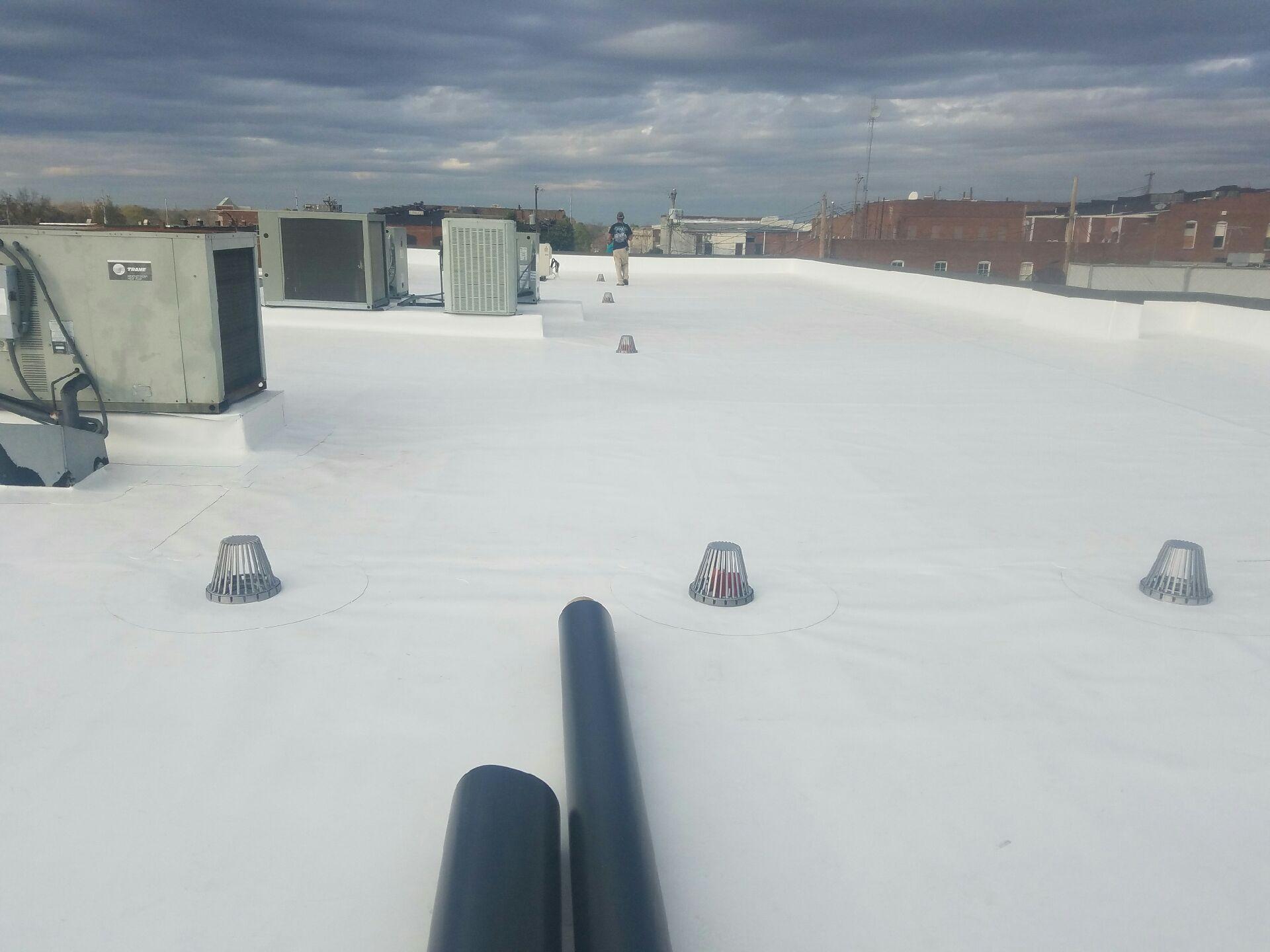
PVC Roofing earns its place in the St. Petersburg commercial roofing market through a specific performance advantage that TPO — its more commonly specified competitor — cannot fully match: chemical resistance to grease, fats, cooking oils, and the hydrocarbon-laden exhaust from commercial kitchen ventilation systems. Along Central Avenue, 4th Street North, and the restaurant-dense corridors of downtown St. Pete, the concentration of food and beverage operations creates a rooftop environment that degrades TPO membranes prematurely. Grease exhaust deposits from commercial kitchen exhaust fans attack TPO's polymer chemistry over time, softening the membrane surface and compromising seam integrity in the areas immediately downwind of exhaust discharge points. PVC's inherent chemical resistance to these compounds is the primary reason it remains a relevant specification in St. Pete's vibrant food and hospitality market.
Bayfront Health St. Petersburg's hospital campus represents another Pinellas County application segment where PVC's chemical resistance matters. Hospital cafeteria and food-service kitchen buildings, pharmaceutical preparation areas, and laboratory buildings with chemical exhaust to the roof surface all present the kind of chemical exposure profile where PVC's resistance to a broad range of organic and inorganic chemical compounds provides a meaningful performance advantage over standard TPO. Commercial kitchens in St. Pete Beach and Tierra Verde waterfront resort hotels — properties with multiple restaurant and bar operations operating year-round — represent the same specification case at a smaller scale, where PVC at exhaust discharge areas prevents the localized membrane degradation that would otherwise require periodic TPO patch replacement in those zones.
PVC's heat-weldable seam technology is shared with TPO and provides the same key advantage over adhesive-bonded seam systems: a weld that, when properly executed, creates a molecular bond between membrane sheets that is stronger than the membrane itself. In Pinellas County's hurricane environment, seam integrity is not an abstract performance metric — it is tested directly by wind uplift forces that concentrate at membrane laps, and by sustained wind-driven rain that pressurizes every seam detail on a roof during the hours of a hurricane event. Hot-air welded seams on PVC and TPO systems consistently outperform adhesive-bonded lap seams on EPDM and early-generation modified bitumen in the wind-driven rain conditions that define St. Pete's most severe weather events.
The plasticizer migration concern that applies to standard PVC — and that makes KEE roofing a preferred alternative for the most demanding chemical and UV-exposure applications — is relevant context for PVC specifications in Pinellas County's subtropical environment. Standard formothyl-grade PVC does contain plasticizers that can migrate over time in sustained high-temperature exposure, potentially reducing membrane flexibility and contributing to brittleness at low-temperature extremes. St. Petersburg has essentially no cold-temperature extreme events, so cold-weather brittleness from plasticizer migration is not a meaningful local concern. The relevant question for PVC service life in Florida is whether the membrane retains adequate flexibility for thermal cycling and penetration flashing accommodation at summer surface temperatures — a performance dimension where current commercial-grade PVC formulations perform adequately through their rated service life in this climate.
White PVC provides cool-roof energy performance equivalent to white TPO — both achieve Solar Reflectance Index values of 90 or higher in initial testing, and both qualify for ENERGY STAR certification as cool-roof products. In the Central Avenue restaurant corridor, an PVC roof selected primarily for grease resistance also delivers the reflectivity and thermal emittance that reduces cooling loads on a commercial kitchen building already generating significant internal heat loads. The energy savings from a cool PVC roof on a St. Pete food-service building offset a portion of the PVC cost premium over TPO, making the net additional cost of choosing PVC for its chemical resistance smaller than the raw material cost differential suggests.
Flashings on PVC systems require specific material compatibility considerations that affect how details are executed in the field. PVC membranes are incompatible with certain adhesive formulations and with some types of foam insulation — specific chemical interactions can cause membrane degradation at contact points. This compatibility requirement means that cover tape, pipe boot, and curb flashing details on an PVC installation must use PVC-compatible accessory products rather than the TPO-compatible products used on an adjacent building. On St. Pete's mixed-use restaurant buildings where rooftop equipment density is high — HVAC curbs, exhaust fans, gas supply lines, and electrical conduit all within a relatively small roof area — the penetration inventory during an PVC installation is dense and requires careful accessory product management to ensure compatibility throughout.
Barrier island resort and hospitality roofing in St. Pete Beach, Treasure Island, and Madeira Beach presents a case where PVC's combination of chemical resistance, weldable seams, and white reflectivity makes it a natural specification for multi-function resort kitchen buildings. These properties typically operate multiple food and beverage venues — pool bars, main restaurants, catering kitchens — with dense exhaust fan populations on their flat roofs. An PVC installation across all food-service roof areas on a barrier island resort provides uniform chemical resistance, consistent maintenance requirements, and a single-membrane specification that simplifies warranty management compared to a hybrid approach using different membranes in different zones of the same rooftop.
Installation timing for PVC work in St. Pete follows the same constraints as other heat-weldable membranes: surface cleanliness and dryness at weld time are non-negotiable, afternoon thunderstorm seasons require morning installation windows, and heat-welder calibration for ambient conditions matters for seam quality. PVC seams require slightly different temperature calibration than TPO seams due to PVC's different polymer chemistry and optimal welding temperature range. Crews trained exclusively on TPO need calibration guidance when transitioning to PVC work — a detail that matters less on large open commercial roofs but significantly on dense-penetration food-service buildings where the proportion of field seam area to total welded length is high.
Questions Owners Ask
Is PVC Roofing worth the extra cost over TPO for my St. Pete restaurant building?
If your roof has direct exhaust fan discharge from a commercial kitchen, or if your HVAC return is picking up cooking exhaust that deposits on the roof surface, PVC's chemical resistance advantage justifies the cost premium — typically 15 to 25 percent above comparable-quality TPO on a per-square-foot installed basis. If exhaust exposure is minimal or absent, TPO provides equivalent performance at lower cost. We assess the exhaust discharge configuration and anticipated deposit pattern on your specific building before recommending either system, rather than applying a blanket recommendation.
Can PVC be used alongside TPO on a building where only part of the roof is exposed to kitchen exhaust?
Yes — a hybrid approach using PVC in the kitchen exhaust zone and TPO across the remaining roof area is a cost-effective strategy that targets chemical resistance where it is needed without applying the PVC premium to the entire roof. The transition between PVC and TPO zones requires specific flashing detailing, as the two membranes cannot be heat-welded directly to each other. Transition flashings using compatible bridging materials between the two membrane systems are standard practice on mixed-system commercial roofs and are included in our specification documentation for hybrid installations.
How long does an PVC roof last on a St. Petersburg commercial building?
Quality commercial-grade PVC systems on properly maintained St. Pete commercial buildings achieve 20 to 25 year service lives — similar to TPO in low-chemical-exposure applications, and meaningfully longer than TPO in kitchen exhaust applications where TPO degrades faster. Annual maintenance visits, drain clearing, and sealant inspection at penetrations are the primary maintenance inputs that determine whether a system reaches the top of that service life range or requires attention at 15 years.
Does PVC Roofing qualify for ENERGY STAR or cool-roof energy incentives in Florida?
Yes. Commercial-grade white PVC Roofing products meet ENERGY STAR low-slope roofing requirements (minimum 0.65 Solar Reflectance after three-year weathering). The same Duke Energy Florida and TECO commercial efficiency programs that apply to TPO and silicone-coated systems are available for PVC installations meeting the applicable reflectivity thresholds. We provide CRRC product data sheets for the specific PVC products we install that document SRI ratings for use in incentive program applications and LEED or FGBC credit submissions.
My PVC roof is 15 years old and still not leaking. Does it need to be replaced?
Not necessarily — age alone is not the replacement criterion. A 15-year-old PVC roof in good physical condition, with intact seams, sound penetration details, and adequate membrane thickness remaining, may have 5 to 10 years of additional service life. We assess remaining life by measuring membrane thickness (thickness reduction from the original gauge indicates UV surface erosion), evaluating seam integrity by probe testing, and inspecting flashing and termination conditions. If these assessments are favorable, a coating or sealant maintenance program may be all that is needed. If seam integrity is deteriorating or membrane thickness is below threshold, planning for replacement in the near term is the responsible approach.
 Commercial Roof Repair in St. Petersburg | Planned & Emergency
 Commercial Re-Roofing
 Occupied Building Re-Roofing
 Roof Recover and Overlay