
Hail is not St. Petersburg's most dramatic weather threat — that distinction belongs to hurricanes — but it is a more frequent cause of commercial roof damage than many Pinellas County property owners recognize. The same convective thunderstorm systems that drive the area's intense afternoon rainfall events during wet season can produce hail, particularly in spring and early summer when strong upper-atmospheric wind shear accompanies the first significant convective development of the season. St. Pete hailstones are characteristically smaller than the large hail events that devastate commercial roofing in Texas or Colorado — marble-sized (0.75 inch) to quarter-sized (1.0 inch) events are most common — but cumulative pitting and bruising from multiple events across a season accumulates into meaningful membrane degradation over three to five years.
The area most susceptible to organized hail-producing storm cells in the Tampa Bay metro tends to be the inland arc from southern Hillsborough County through northern Pinellas — which places the Gateway area, the Airco Aviation Business Center vicinity near St. Pete-Clearwater International Airport, and the Pinellas Park industrial corridor directly in the path of spring convective development. Industrial and light-commercial buildings in these zones often sustain hail damage that goes unidentified for months or years, gradually manifesting as premature membrane aging, cracked TPO seams in previously hail-bruised areas, or spalling cap-sheet granules washing into drains from modified bitumen surfaces that sustained direct hail impact.
TPO membrane is the most common substrate for hail damage assessment in Pinellas County, and proper assessment requires more than a visual walk of the roof surface. Hail impacts on TPO leave characteristic circular depressions or stress marks in the membrane surface — often not immediately visible from standing height but clearly identifiable under raking light conditions or by manual palpation of the surface. More critically, the area around a hail impact site in TPO develops micro-level tensile stress in the membrane that reduces its elongation capacity and makes those areas vulnerable to seam separation under thermal cycling or wind load. A TPO roof with widespread hail-bruise density across its field area is at elevated risk of seam failure in subsequent weather events, even if no individual impact has yet penetrated the membrane surface.
Modified bitumen cap sheets — the APP or SBS-modified surfaces on many older downtown St. Pete and Warehouse Arts District commercial buildings — respond to hail differently. The granular surface of a cap sheet absorbs and scatters the impact energy of small hailstones across a wider surface area than the smooth surface of TPO, making direct perforation less likely from typical St. Pete hail sizes. However, hail impact displaces and erodes the embedded granules that provide UV protection to the underlying bitumen — a process that accelerates UV oxidation and shortens the membrane's expected service life. A modified bitumen roof that has sustained multiple hail events will show areas of granule displacement, accelerated surface oxidation, and eventual cracking at impact sites that begin allowing water infiltration through a surface that has lost its protective aggregate layer.
Insurance claim documentation for hail damage on St. Pete commercial buildings follows a specific protocol that differs from hurricane claim documentation in important ways. Hail damage is a point-in-time event tied to a specific storm date, which means establishing the damage timeline relative to your policy effective date and any recent inspections is critical for claim eligibility. If you have a pre-storm baseline roof inspection report on file — a document we recommend for all Pinellas County commercial owners as a standard practice — it establishes the pre-event condition and makes the before/after comparison straightforward for both your adjuster and any public adjuster involved in the claim. Without pre-event documentation, demonstrating that hail damage is recent rather than pre-existing aging becomes a dispute that can reduce or eliminate claim recovery.
Full hail damage restoration on a commercial building in St. Pete typically involves one of three approaches based on the damage extent and the underlying system's remaining life: targeted membrane repair over impact-damaged areas with replacement of penetration flashings that sustained direct impacts; a full silicone or acrylic coating system that seals hail-bruised areas and restores the membrane surface against further weathering; or full membrane replacement when core-cut assessment reveals that hail impacts have driven moisture into the insulation assembly or when widespread bruise density makes the remaining membrane life inadequate for the building's needs. We recommend against full replacement without infrared scanning and core cuts — hail damage that looks severe visually sometimes leaves the insulation assembly intact and allows a coating or repair approach that costs substantially less.
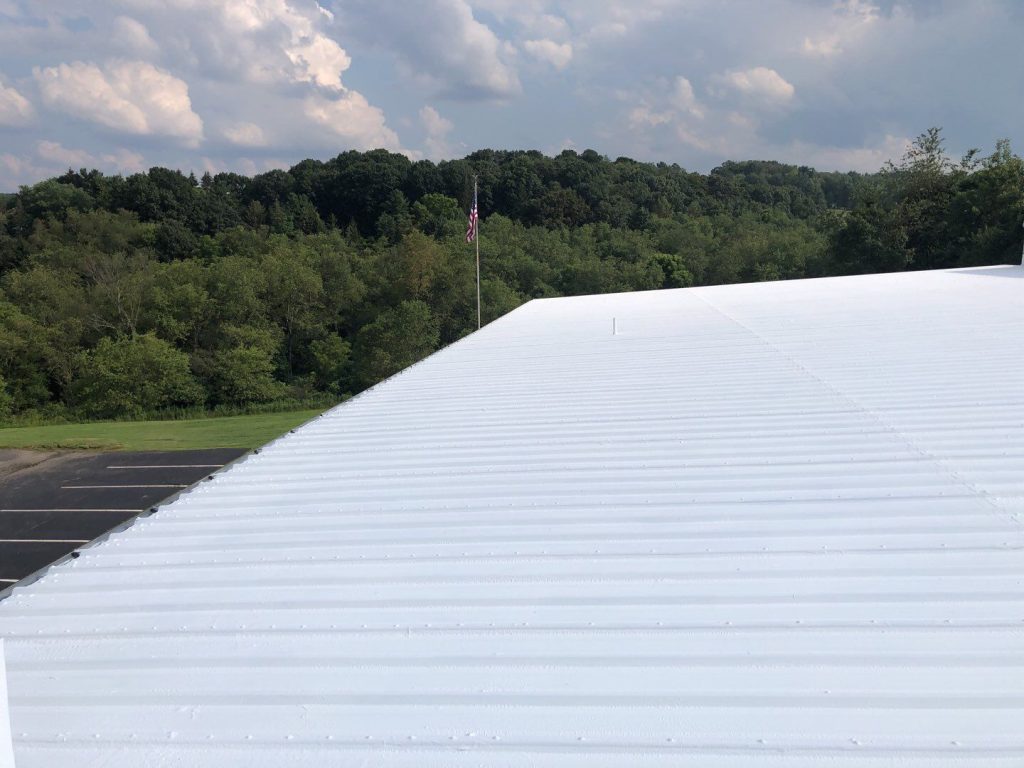
The aviation-related commercial and industrial facilities near St. Pete-Clearwater International Airport and the Airco Aviation Business Center warrant specific mention in any Pinellas County hail discussion. Metal R-panel and standing seam metal roofing on aviation facilities sustains hail impact in a visually dramatic way — denting in the exposed panel field — that can appear worse than the actual performance impact. A dented metal panel has not lost its weathertightness unless the dent includes a fastener that has backed out or a seam that has deformed. We assess aviation-area metal roofing hail damage with the same systematic approach applied to membrane systems: extent of panel deformation, fastener status, seam continuity, and whether any penetrations or transitions were displaced by impact — not simply a count of visible dents.
Questions Owners Ask
How do I know if my building sustained hail damage during a recent storm?
Several indicators suggest hail damage worth investigating: visible denting on soft metal components like HVAC equipment housings, vent caps, or gutter sections; new interior leaks or ceiling stains appearing within days after a storm event with no recent rainfall issues; visible granule deposits in gutters or at downspout outlets from modified bitumen or granule-surfaced membranes; or news reports confirming hail in your specific area of Pinellas County during a recent event. Any of these warrants a professional roof inspection with specific attention to hail impact patterns rather than just general condition assessment.
Will my commercial property insurer cover hail damage on my Pinellas County building?
Most commercial property policies cover hail damage as a named peril. However, Florida commercial property insurance has become substantially more restrictive in recent years regarding storm damage claims, and specific policy exclusions for cosmetic damage, pre-existing conditions, or damage below policy deductibles are common. Review your policy declarations for actual cash value versus replacement cost coverage — ACV policies depreciate the claim payment based on membrane age, which can significantly reduce recovery on older roofing systems. We can assist with claim documentation to maximize covered damage recovery under your policy's applicable terms.
Can a hail-damaged roof be coated rather than replaced?
Yes, when the underlying insulation assembly remains dry and the membrane structural integrity is not compromised at impact sites. A silicone coating applied over a hail-bruised TPO or modified bitumen membrane that has sustained surface damage without full penetration can seal the affected areas, restore waterproofing integrity, and add UV protection that extends total system life. Core cut confirmation of dry insulation is required before any coating approach is recommended — hail that has driven moisture into the assembly through seam failures or open punctures is a different situation that may require targeted insulation replacement before coating.
Is spring or summer hail covered under my hurricane insurance policy, or is it a separate coverage?
Hail damage is typically covered under the general windstorm or all-risk coverage section of a commercial property policy, not under the separate hurricane deductible provisions that most Pinellas County policies include. Policies with percentage-based hurricane deductibles (typically 2 to 5 percent of insured value) apply those deductibles only to named storm damage — non-named-storm hail events trigger the standard per-occurrence deductible, which is usually substantially lower. Confirm with your insurance broker how your specific policy defines covered storm types and which deductible applies to hail events.
How long after a hail event can I still file an insurance claim?
Florida law requires insurance carriers to investigate claims promptly, but policy provisions typically require notice of loss within a reasonable time after the event. Most Florida commercial property policies require reporting within one to three years of the loss date, but reporting sooner is always better — delay allows the insurer to argue pre-existing conditions. If you suspect your building sustained hail damage during a recent event, contact your carrier to open a claim and schedule a professional damage inspection promptly rather than waiting for further evidence of damage to develop.
 Commercial Roof Repair in St. Petersburg | Planned & Emergency
 Commercial Re-Roofing
 Occupied Building Re-Roofing
 Roof Recover and Overlay